


Brain Injury Lawyers in Pompano Beach, FL
Traumatic brain injury cases may involve memory loss, cognitive changes, headaches, mood issues, and long term disability. Because symptoms can worsen over time, early medical care and strong legal documentation matter. An attorney can pursue compensation for treatment, rehabilitation, income loss, pain, and future care.
When people hear “traumatic brain injury” (TBI), they often think of the most extreme outcomes, like paralysis or death. But many brain injuries are less obvious and can still seriously affect your health and everyday life.
If you or someone you love suffered a brain injury in an accident, you may be able to seek compensation, even if you were partly at fault. Long & Jean, P.A. represents injury victims in Pompano Beach on a contingency fee. That means you don’t pay upfront; we only get paid if you recover money through a settlement or court award.
Before you accept any insurance settlement, it’s important to speak with an attorney. Contact LJ Legal today.
What is a Traumatic Brain Injury?
A traumatic brain injury happens when a sudden impact or force damages the brain or the area around it. A TBI can affect how you think, feel, and act. It can also impact memory, mood, coordination, and day-to-day functioning, including your relationships with others.
Types of Brain Injuries
TBIs are categorized as Mild, Moderate, and Severe on the Glasgow Coma Scale, and there are numerous types of TBIs:
- Concussions – These are usually caused by a blow to the head that causes the brain to shift or change position.
- Contusions – A bruise or bleeding on the brain. While these are typically mild, they can be severe enough to require surgery.
- Coup-Countrecoup Injury – This occurs when the impact causes injury at the point of impact and then on the opposite side of the brain. The opposite-side injury is from the brain slamming into the inner wall of the skull.
- Diffuse Axonal Injury (DAI) – Usually a severe brain injury caused by the head rapidly accelerating or decelerating.
- Penetrating Injury – As the name indicates, this occurs when an object penetrates the brain. Penetrating injuries are almost always severe. The type of damage depends on the damage around the wound, the speed, and the region of the brain that’s affected.
- Anoxic Brain Injury – This is a type of brain injury caused by lack of oxygen.
The symptoms of brain injuries range from mild symptoms like dizziness, nausea, or fatigue all the way to full or partial paralysis and death.
Leading Causes of TBIs
According to the CDC, fall injuries are the number one cause of traumatic brain injuries, followed by events where the victim was struck by or against objects, followed by vehicle accident injuries.
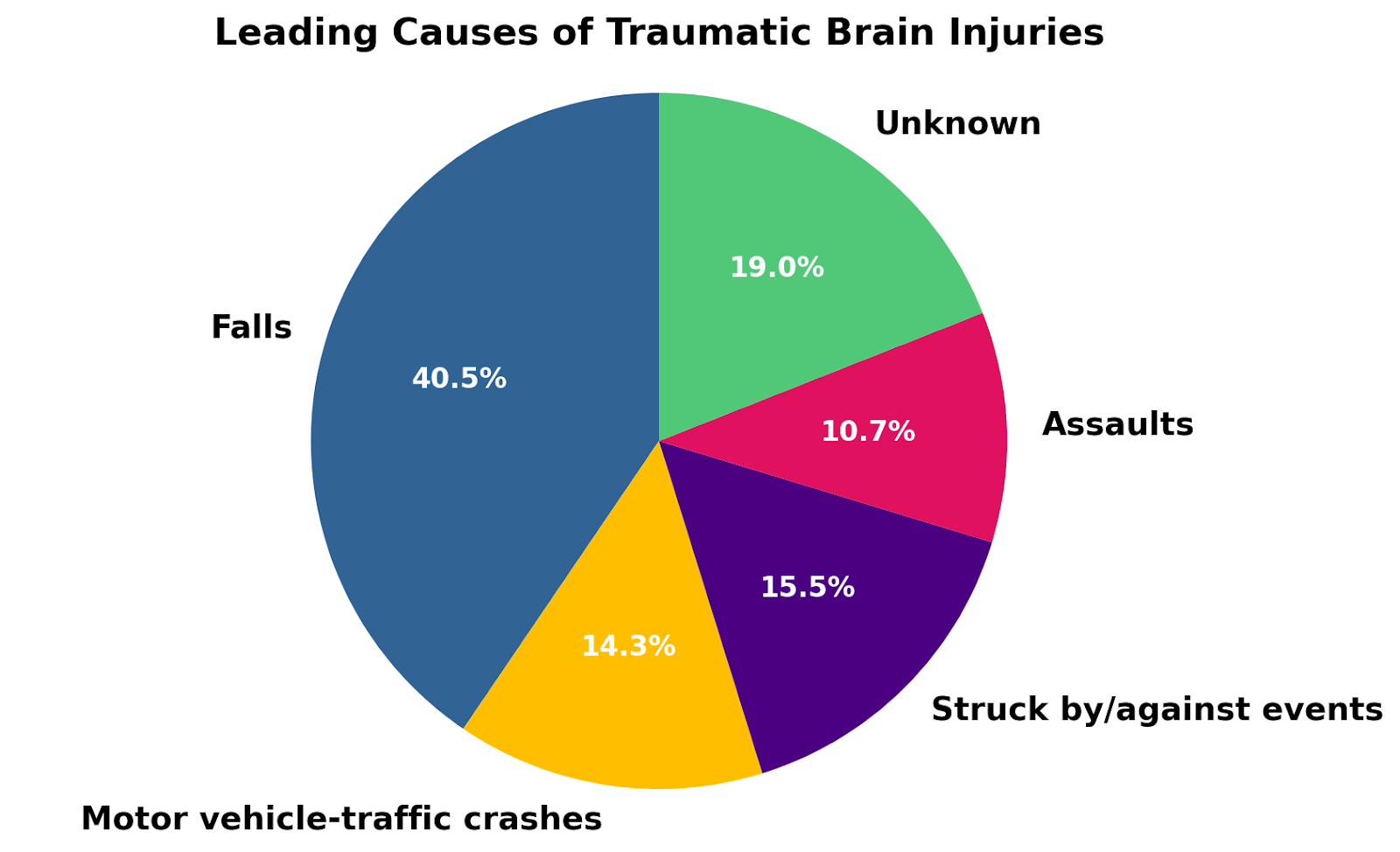
Source: U.S. Centers for Disease Control and Prevention
Understanding Traumatic Brain Injuries and Their Effects
A traumatic brain injury (TBI) occurs when a sudden trauma disrupts normal brain function, often caused by a blow, jolt, or penetrating injury to the head. These injuries are classified as mild, moderate, or severe, depending on the extent of neurological impairment and loss of consciousness.
Even so-called “mild” TBIs, such as concussions, can have lasting repercussions on a person’s cognitive, emotional, and physical well-being. Individuals may suffer from memory loss, difficulty concentrating, mood swings, or motor function deficits. In more severe cases, TBIs can result in permanent disability or the need for lifelong care.
For those suffering from a brain injury in Florida, understanding the long-term impact is crucial when considering legal options. A qualified traumatic brain injury attorney in Florida can help quantify both economic damages for TBI, such as ongoing medical expenses and lost wages, and non-economic damages for brain injuries, like emotional distress and loss of enjoyment of life.
These distinctions are vital when pursuing TBI compensation claims, especially when the injured party’s life is fundamentally altered by the injury. For more information, familiarize yourself with the educational materials available from the CDC on brain injury.
Common Causes of TBIs in Florida
In Florida, the following circumstances are responsible for the majority of traumatic brain injuries in the state:
- Motor Vehicle Accidents
- Car, truck, and motorcycle accidents are leading causes of TBIs in Florida.
- High-speed collisions and violent impacts increase severity.
- Slip and Fall Accidents
- Particularly common among the elderly in homes, nursing facilities, or public spaces.
- Wet floors, uneven surfaces, and poor lighting are key risk factors.
- Sports and Recreational Activities
- Contact sports, such as football, soccer, or boxing, can result in severe trauma.
- Boating and diving accidents are also especially prevalent in Florida’s coastal communities.
- Violence and Assault
- Gunshot wounds, domestic violence, and child abuse often result in TBIs.
- Florida experiences a significant number of TBIs from violent altercations.
- Workplace Accidents
- Falls from heights, falling objects, or incidents involving heavy machinery on construction sites.
- A lack of safety protocols or personal protective equipment (PPE) can be a contributing factor.
- Bicycle and Pedestrian Accidents
- Florida has high rates of pedestrian and cyclist accidents involving head injuries.
- These scenarios are often caused by distracted driving or poor infrastructure.
How to Prevent Brain Injuries in High-Risk Situations
Preventing TBIs begins with awareness and proactive safety measures. In everyday situations, wearing seat belts, using child safety restraints, and adhering to traffic laws significantly reduce the risk of head trauma in car crashes. Property owners can prevent slip and fall accidents by maintaining safe walkways, installing handrails, and ensuring adequate lighting. In sports and recreational activities, proper use of helmets and protective gear is essential, especially in Florida, where outdoor activities are year-round.
In occupational settings, adherence to OSHA standards and workplace safety protocols can protect employees from life-altering injuries. Employers must provide personal protective equipment and safety training, particularly in industries that involve construction, machinery, or working at heights. If safety violations result in an injury, a personal injury lawyer for brain injuries can explore options beyond workers’ compensation, such as third-party liability claims.
Seeking guidance from well-respected law offices when searching for “brain injury attorney near me” can provide crucial protection and advocacy in high-risk environments.
Steps to Take After a Brain Injury
If you have suffered a TBI as a result of someone else’s negligence, here are the proper steps to take after an accident.
- Seek Immediate Medical Attention – Call 911 or go to the emergency room, even if symptoms seem mild. Early diagnosis through CT scans or MRIs can prevent worsening conditions. Your health and safety are the top priority, always.
- Document the Incident – Collect witness information, take photos, and preserve evidence (if possible). Keep all medical records, police reports, and any correspondence related to the event in a secure and easily accessible location.
- Follow All Medical Recommendations – Attend follow-up appointments, physical therapy, and cognitive rehabilitation. Monitor your recovery progress and note any delayed symptoms, such as headaches, memory loss, or mood changes.
- Notify Insurance Providers – Report the incident to auto, health, or property insurance as required. Be cautious about giving recorded statements without legal counsel. The purpose is to document your accident before agreeing on any settlement.
- Consult with a Brain Injury Attorney – This is especially critical in the event that the injury was caused by another’s negligence. An attorney can help determine liability, file claims, and pursue compensation.
- Emotional and Psychological Support – Seek counseling or support groups during your recovery process, as brain injuries can profoundly impact mental health, family dynamics, and lifestyle.
Why Legal Representation Matters in TBI Cases
Navigating the legal landscape after a traumatic brain injury requires skilled legal counsel, especially when dealing with complex medical evidence, insurance companies, and long-term prognosis evaluations.
A seasoned brain injury lawyer in Pompano Beach understands how to build a compelling case supported by expert testimony, medical records, and financial projections. This is crucial in cases involving comparative negligence in TBI cases, where partial fault may be assigned to the injured party and could affect the final settlement under Florida law.
Retaining the best brain injury attorney near me ensures that your rights are protected from the outset. A qualified lawyer will fight to recover full compensation for both economic and non-economic damages, navigate insurance negotiations, and represent you in court if necessary.
Most Florida brain injury law firms, including Long & Jean P.A., offer free consultations and work on a contingency fee basis, meaning there is no upfront cost to pursue justice. With the right representation, victims of TBIs can focus on recovery while their attorney handles the complex legal matters critical to their long-term well-being.
The Benefits of Legal Assistance After a Brain Injury
When most people are injured, their first inclination is to seek medical attention, and that’s exactly what they should do. Your immediate health consideration should take priority. That does not, however, mean that you should neglect the financial and legal considerations of the case.
Even a mild head trauma can lead to tens of thousands of dollars of medical costs and lost wages, not to mention the physical pain and emotional suffering that accompany a brain injury.
Personal injury lawyers perform several services for their clients:
- Case review to determine the legal viability of the TBI claim
- Calculation of economic and non-economic damages
- Depose witnesses to the accident
- Collect medical records, police reports, and other documentation
- Review the discovery evidence provided by the insurance company attorneys
- Prepare a demand letter for the insurance company
- Negotiate the claim
- Prepare letters of protection (LOPs) so doctors can work on your case with the confidence of being paid from the proceeds of the settlement or court award
- File a lawsuit with the civil court
- Represent the client in all pretrial motions
- Represent the victim in court
- Distribute the proceeds of the settlement to all parties who are owed money
When LJ accepts your brain injury case, you can rest assured that they know the physical and emotional pain that you’re experiencing. You can count on our professionalism, experience, and compassion. Call today, and you’ll immediately realize the difference.
Seeking Legal Representation for Your TBI Case
Most people have no idea how to choose a lawyer for their case. They may use arbitrary selection criteria like name recognition from an ad, the word of a family member, or a friend.
What you should know about brain injury personal law is that it’s extremely competitive. Personal injury law offices will go to great lengths to ensure that you remember their name, just in case you’re involved in an accident.
However, name recognition is a poor way to choose a law firm. Here are some things that you should know when you’re vetting personal injury lawyers.
All Personal Injury Lawyers Work on a Contingency Basis
This is common practice for personal injury law firms. However, some firms may try to charge an initial consultation fee. There is no reason for you to pay out-of-pocket to an attorney just to discuss your TBI case.
The Florida Bar Establishes Contingency Fees
Contingency fees are established by the Florida Bar. Consequently, it doesn’t make a lot of sense to price shop. Before committing to any law firm, however, you should request a written breakdown of their contingency fee schedule. The fees are:
- 33⅓ percent of any recovery up to $1 million if the attorney settles before the filing of an answer or demand appointment of arbitrators expires.
- 40 percent of any recovery up to $1 million if the attorney settles after.
- 30 percent of additional recovery between $1 million and $2 million.
- 20 percent of any recovery in excess of $2 million.
For example, if your brain injury case settles for $5 million before an answer or demand of arbitrators, your attorney would collect $333,333 on the first million, $300,000 on the second million, and $600,000 on the remaining three million, for a total contingency fee of $1,233,333.
Brain Injury Attorney Experience Matters
Some attorneys have worked dozens or even hundreds of cases but have never handled a brain injury case. Because TBI cases involve extensive investigation and medical testimony from experts in the field, choosing a legal team with TBI experience is essential.
An experienced lawyer will be familiar with the best neurologists in the area who will accept letters of protection. In addition, they are familiar with the top accident investigators and medical experts. This can be the difference between a large recovery and a failed case.
Review Client Testimonials
Successful law firms are proud of the relationships they build with their clients.
Check out the law firm’s testimonial page to read ratings and reviews.
The Legal Process for Brain Injury Claims
Every case is unique, so your brain injury case may not follow these steps. However, once you have representation, your attorney should be able to keep you apprised of the developments of your case.
Find an Attorney
After addressing your medical issues, hiring an attorney should be your first priority. You can take a few days to meet with several lawyers, but don’t wait too long before choosing. At LJ, we are confident in what we offer our injury clients. Many people who contact us end their search as our clients.
Initial Consultation
During your initial consultation, you will tell your attorney what happened to you and what measures you’ve taken so far. It’s important that you’re forthcoming about any discussions you’ve had with insurance adjusters or attorneys who work for the defendant. The attorney will ask you questions and determine the viability of their case. They should also explain to you their fee structure. If they don’t, make sure to ask.
Evidence Collection
Your attorney should begin collecting evidence immediately after accepting you as a client. Evidence can be lost or destroyed over time, and witnesses can move away. Among other things, your attorney will gather police records, medical records, CCTV video evidence, and photographs of the accident scene. They will also compile a list of eyewitnesses for deposition.
Damage Calculations
Your attorney will calculate all expenses related to the accident. These are economic damages. They will also use established formulas to calculate your pain and suffering or non-economic damages. This will be essential when negotiating a claim.
Filing an Insurance Claim
If the accident or incident is covered under an insurance policy — car insurance, property insurance, workers’ comp, etc. — your attorney will file a claim on your behalf. If you’ve already filed a claim but didn’t accept payment, they can still represent you in your pursuit of compensation.
Here are some common mistakes to avoid when filing a claim.
Filing a Lawsuit
While most personal injury cases never make it to the litigation phase, it’s essential that your attorney file in a timely manner. The Florida statute of limitations for most accidents is four years from the date of the accident. Filing not only places pressure on the responsible parties, but it also allows time for the discovery phase of the suit and the various motions that occur in civil litigation cases.
Negotiation
To avoid litigation, which can be risky for both sides, your legal team will negotiate with the defense’s lawyers. If the sides are too far apart, however, the case may go to trial. Long & Jean, P.A. will never press our client to accept a less-than-favorable settlement. If you don’t agree to the terms, we will keep pursuing appropriate compensation on your behalf.
Trial
If the parties cannot agree on a settlement, your case goes to trial. During the trial, both sides will present their arguments and evidence. The court will ultimately decide the amount of the settlement.
Important Legal Concepts for Brain Injury Cases
At LJ, our team will make sure you’re well-informed about all legal matters affecting your case. However, these concepts are particularly useful.
Statute of Limitations
Many of our brain injury clients are concerned about filing ahead of the statute of limitations. While you should not delay starting your legal claim, you may be relieved to know that the statute of limitations in Florida is four years from the date of the accident for most cases. There are exceptions, however.
If your brain injury is the result of medical malpractice, the statute of limitations is two years from the date of the injury. If the medical injury wasn’t discovered until after the incident that caused it, it can be extended to four years. In wrongful death cases, the statute of limitations is two years from the date of death.
Types of Damages
Attorneys attempt to seek monetary damages on behalf of their clients. The state of Florida has three general categories of monetary damages. Economic damages and non-economic damages are compensatory and are not subject to damage caps. Punitive damages are capped at $500,000 or three times the amount of compensatory damages, whichever is greater.
Economic Damages
If you’ve suffered a brain injury, you may incur medical bills, lost wages, and more. Economic damages cover the financial costs associated with an accident.
Non-Economic Damages
Also referred to as “pain and suffering,” non-economic damages attempt to cover intangible injuries from the accident. These can include reduced quality of life, physical pain, and mental anguish. In a wrongful death case, the plaintiff may also claim loss of companionship.
Punitive Damages
In cases where the defendant’s actions were egregious or intentional, the court may award punitive damages. As was previously stated, there are damage caps for this category, and not all cases warrant punitive damages.
Insurance companies are notorious for downplaying damage estimates. Make sure you speak to an attorney before accepting any settlement from the insurance company.
Comparative Negligence
Florida operates on a pure comparative negligence principle. This means that you can recover damages for your brain injury, even if you were partially at fault. Consider this scenario. Another driver runs a stop sign, causing an accident with your vehicle.
However, it was later determined that even though you had the right of way, you were traveling 15 mph over the speed limit, contributing to the extent of your damages. The court may determine that 20% of the accident was your fault. In this case, you would be able to recover up to 80% of your damages.
Frequently Asked Questions in Brain Injury Cases
Our clients commonly ask the following questions. For answers to your specific questions, call a Pompano Beach brain injury attorney at Long & Jean, P.A. for a free, no-obligation consultation.
Who Can Sue in a Wrongful Death Claim Involving a Brain Injury?
In the state of Florida, the estate’s personal representative is the only person who can sue for wrongful death. If this is not a person. However, the estate receives the damage recovery to be distributed to the nearest relative with standing.
What is My Brain Injury Case Worth?
It’s impossible to discuss dollar amounts without knowing the specifics of the case. All brain trauma cases are different, so your award will depend on numerous factors. Determining appropriate damages requires years of training and expertise, so be sure to discuss this matter with an attorney.
How Can I Afford a Brain Injury Lawyer?
Brain injury lawyers typically work on a contingency basis, meaning they do not receive payment until the case is settled or a jury award is obtained. If they recover nothing, the client does not have to pay.
What Should I Do if I Suspect a Brain Injury?
Seek medical attention immediately. Your physical and mental health are of the utmost importance. It will not harm your legal case, and it will help provide a baseline for your medical condition.
How Long Do I Have to File a Brain Injury Claim?
For most claims, the statute of limitations is four years from the date of the accident. However, you should not delay speaking to an attorney. It’s important that they have access to the evidence while it’s still fresh.
What if the Brain Injury Occurred at Work?
Workers’ compensation covers employees regardless of who is at fault. However, these policies often fail to fully cover the injury. Contact us to discuss your workers’ compensation claim and other potential damages.
Why Shouldn’t I Just Accept the Insurance Company’s Settlement Offer?
Within a day of your accident, an insurance adjuster may show up with an offer to settle quickly. They may offer to pay your medical bills and a little extra for your inconvenience. However, you will have to sign a waiver of liability that will prevent you from recovering additional damages. Before accepting any offer from the insurance company, contact us. You’re under no obligation to accept our services, and we will NOT charge you for the consultation.
Contact Our Attorneys Today
For years, Long & Jean, P.A. has been helping patients recover damages from traumatic brain injuries. We offer top-tier representation on a contingency basis. Contact our Pompano Beach law office for a free consultation.